

If you read only one thing about AI this quarter, make it this. Three of the most closely watched research teams in enterprise technology have released their 2026 AI reports. Deloitte surveyed over 3,200 business and IT leaders across 24 countries. McKinsey surveyed roughly 500 organizations on AI trust maturity. NVIDIA gathered over 3,200 responses across financial services, retail, healthcare, telecom, and manufacturing. When three independent research efforts this large all point in the same direction, it is worth paying attention to.
Here is what they collectively found and what it means for your organization.
The Shift From Pilot to Production Is Finally Happening
For years, enterprise leaders have griped about being stuck in what Deloitte refers to as the “proof of concept trap.” A pilot with a small team, clean data, and an isolated environment can be executed in a few months. Production needs infrastructure investment, security reviews, compliance checks, integration with existing systems, and ongoing maintenance. Many of the use cases that look like three-month projects turn into 18 months when you get into real-world complexity.
That’s starting to change.
Deloitte said 50 percent of the workforce has access to AI now, up from less than 40 percent just one year ago, with about 60 percent of workers having sanctioned AI tools.

NVIDIA reports that 64 percent of organizations are actively using AI in their operations today, with 28 percent still assessing its use, and 8 percent not using AI at all. North America has the highest active usage, at 70 percent, followed by EMEA at 65 percent and APAC at 63 percent.
More importantly, Deloitte found that 25 percent of organizations have moved 40 percent or more of their AI experiments into production. That may sound modest, but 54 percent expect to reach that level within the next three to six months. The pipeline is filling. The shift from experimentation to scaled deployment is no longer theoretical. It is happening now.
This transition is the single most important inflection point for enterprise AI. Pilots are cheap and low risk. Production is where value is either created or destroyed. The organizations that treat this transition as a technical upgrade will struggle. The ones that treat it as an operating model redesign will pull ahead.
Agentic AI Is Coming Fast, and Governance Is Not Ready
All three reports name agentic AI (systems that can set goals, reason through multi-step tasks, use tools and APIs, and coordinate work with people or other agents) as the next major wave. Deloitte found that 23 percent of companies are already using agentic AI at least moderately, but that number is expected to jump to 74 percent within two years. Security and risk concerns are the primary obstacle to scaling agentic AI, with nearly two-thirds of respondents citing this issue, McKinsey found. One of the defining themes of 2026, according to NVIDIA, is the rise of agentic AI.
The trouble is this. It’s not only the recommendations that these autonomous systems make. They do. They can buy things, send messages, or change systems. McKinsey says organizations can't be satisfied with AI systems that say the wrong thing anymore. Now they have to deal with systems doing the wrong thing.”
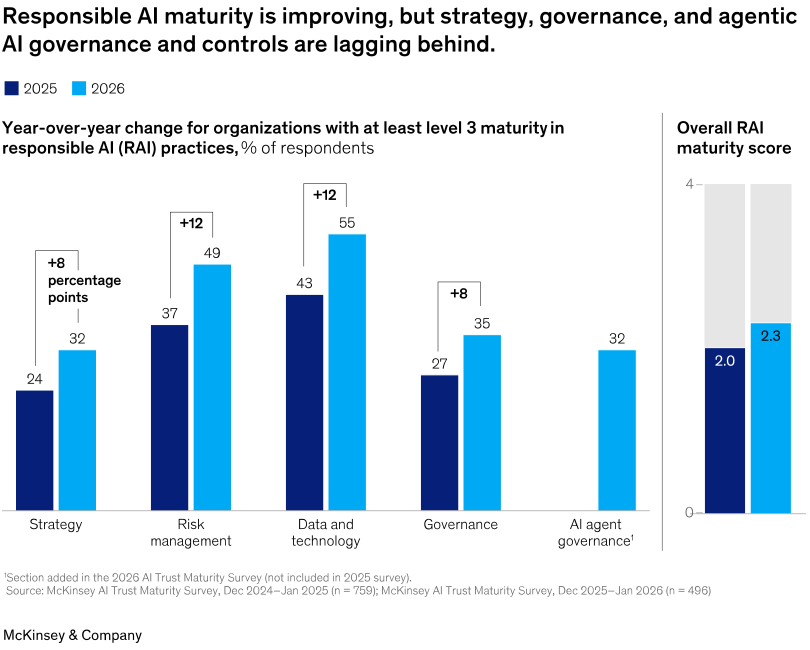
According to McKinsey’s AI Trust Maturity Survey, the average responsible AI maturity score increased to 2.3 in 2026 from 2.0 in 2025. But only 30 percent of organizations reached a strategy, governance, and agentic AI control maturity level of three or above. Deloitte says just 21 percent of companies say they have a mature model for governing autonomous agents. Meanwhile, 74% expect to deploy agentic AI within two years.
That is a dangerous gap. You cannot safely deploy agents at scale if only one in five companies has mature governance. Deloitte warns that rushing to deploy agents widely before establishing governance foundations can expose organizations to significant risk. McKinsey adds that active mitigation lags behind risk awareness across nearly every AI risk category.
Trust Is Becoming a Business Enabler, Not a Compliance Burden
McKinsey makes a point that deserves more attention than it gets. AI trust is increasingly viewed as a business enabler rather than a compliance exercise. Organizations that invest 25 million dollars or more in responsible AI initiatives report significantly higher maturity scores and are far more likely to realize material AI benefits, including EBIT impact above 5 percent.
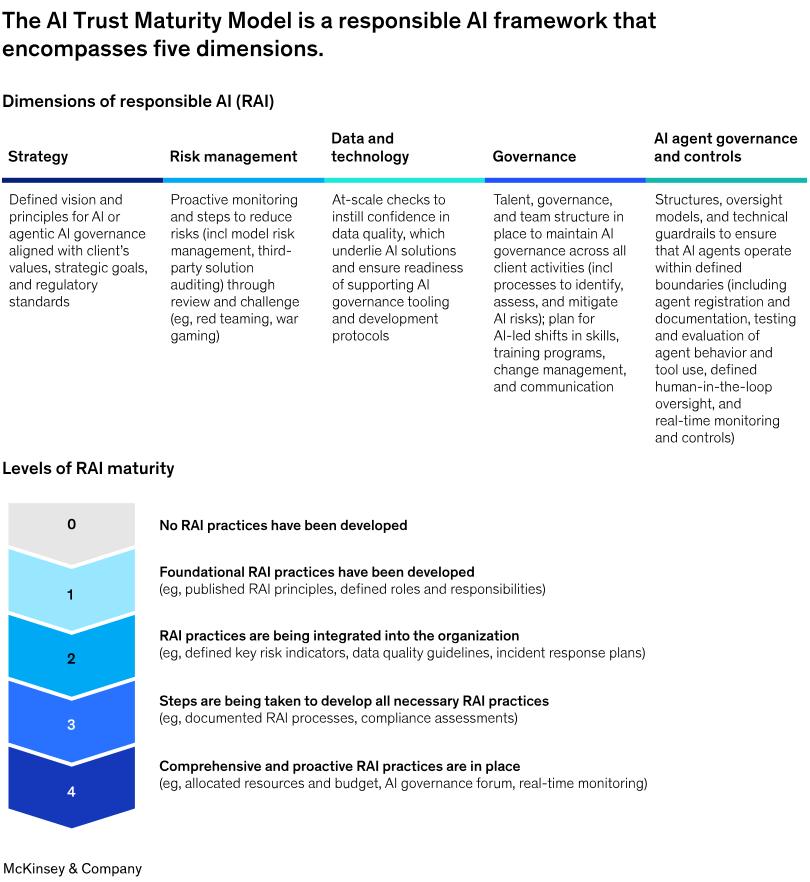
This flips the old narrative. For years, governance was seen as a tax on innovation, a box-checking exercise that slowed teams down. The data now says the opposite. Companies with explicit accountability for responsible AI achieve higher maturity scores than those without clear accountability. Trust is not a brake. It is a prerequisite for speed.
Deloitte reinforces this by noting that governance is the difference between scaling successfully and stalling out. Organizations that treat governance as a strategic capability, not an afterthought, are positioned to scale AI quickly and safely. Those who treat it as a checkbox exercise may find themselves unable to move AI from pilot to production, held back by the high risks they failed to address.
The Revenue and Productivity story is getting real.
One of the most persistent criticisms of enterprise AI has been that it is all hype and no return. The 2026 data suggest that criticism is losing its footing.

NVIDIA found that 88 percent of respondents said AI has had an impact on increasing annual revenue. Nearly a third reported a significant increase of more than 10 percent. Over 40 percent of C-suite or vice president-level respondents saw annual revenue increase by more than 10 percent. On the cost side, AI is driving down annual costs while boosting productivity.
Deloitte found that 66 percent of organizations are already achieving efficiency and productivity improvements from AI. However, only 20 percent are already increasing revenue, while 74 percent hope to do so in the future. This suggests the revenue impact is real but still early. The productivity gains are here now. The revenue transformation is coming.
NVIDIA's industry breakdown shows where the impact is strongest. In telecommunications, 99 percent of respondents said AI helped improve employee productivity. In manufacturing, PepsiCo's work with Siemens and NVIDIA to create digital twins of its facilities delivered a 20 percent increase in throughput and 10 to 15 percent reductions in capital expenditure by identifying up to 90 percent of potential issues before any physical modifications.
McKinsey adds that organizations investing heavily in responsible AI are more likely to see these material benefits. The relationship between trust, investment, and value creation is not coincidental. It is causal. When employees and customers trust a system, they use it more deeply. When governance is strong, deployment happens faster and at a greater scale.
The Workforce Gap Is the Silent Killer
All three reports identify talent and workforce readiness as a critical barrier, but they approach it from slightly different angles.

NVIDIA found that the biggest challenge to AI adoption is a lack of AI experts. This is especially acute in smaller companies that do not have the capital to hire data scientists and AI infrastructure specialists. Larger companies with more than 1,000 employees show much broader adoption, with 76 percent actively using AI, compared to 57 percent in companies with fewer than 100 employees.
Deloitte found that insufficient worker skills are seen as the biggest barrier to integrating AI into the business. Yet fewer than half of companies are making significant adjustments to their talent strategies. Most are focused on educating employees to raise AI fluency, but far fewer are rearchitecting roles, workflows, and career paths. A striking 84 percent of companies have not redesigned jobs around AI capabilities.
McKinsey found that nearly 60 percent of respondents cite knowledge and training gaps as the primary barrier to implementing responsible AI practices, up from about 50 percent last year. While executive support has improved, organizations continue to struggle with building the skills and operational muscle required to embed responsible AI consistently across teams.
This is the paradox of enterprise AI in 2026. The tools are better than ever. The infrastructure is more accessible than ever. But the people are not ready. You can buy compute. You can buy models. You cannot buy organizational fluency.
Physical AI and Sovereign AI Are Entering the Picture
Deloitte introduces two emerging themes that enterprise leaders need to understand. Physical AI (systems that perceive the real world and drive physical actions through machines) is already embedded in 58 percent of companies and is projected to hit 80 percent within two years. The Asia Pacific leads adoption at 71 percent today and 90 percent is expected in two years. Manufacturing, logistics, and defense are the early adopters.
Sovereign AI (the idea that where AI is built and hosted matters as much as what it can do) is also gaining traction. Deloitte found that 77 percent of companies now factor an AI solution's country of origin into vendor selection. More than 8 in 10 view sovereign AI as at least moderately important to strategic planning. This is driven by data residency requirements, regulatory complexity, and a desire to reduce dependence on foreign vendors for critical AI infrastructure.

NVIDIA notes that companies are building and deploying specialized AI programs with open source tools to tackle specific challenges. This aligns with the sovereign AI trend, as organizations seek more control over their AI stack.
McKinsey does not focus on physical or sovereign AI specifically, but its finding that Asia Pacific leads in responsible AI maturity connects to Deloitte's data showing APAC's leadership in physical AI adoption. The regions that are deploying AI most aggressively into physical systems are also the ones advancing trust and governance capabilities fastest.
My Take: Where the Real Opportunities and Traps Lie
The 2026 enterprise AI landscape is clear. Adoption is accelerating. Value is materializing. Agentic AI is the next frontier. But governance, workforce readiness, and trust infrastructure are lagging dangerously behind.
I believe the transition from pilot to production is the single most important inflection point for enterprise AI right now. Pilots are cheap and low risk. Production is where value is either created or destroyed. The organizations that treat this transition as a technical upgrade will struggle. The ones that treat it as an operating model redesign will pull ahead.
I also believe the governance gap around agentic AI is where the next wave of enterprise casualties will come from. Companies will deploy agents to automate customer service, supply chain decisions, or financial operations without proper guardrails. When those agents make errors at scale, the damage will be operational, financial, and reputational. The winners will be the companies that slow down enough to build governance first, then scale fast. The losers will scale first and clean up later.
Trust and governance are the ultimate competitive moats in enterprise AI. Any company can buy an AI model. Few can deploy it at scale with confidence. The ones that build trust into their architecture will win enterprise contracts, retain customers, and avoid regulatory backlash. The ones that cut corners will face incidents that erode confidence and invite intervention.
We are crossing the chasm from efficiency play to revenue engine, but unevenly. The companies seeing revenue gains are not the ones using AI to write emails faster. They are the ones using AI to redesign products, create digital twins, and open new business lines. If your AI strategy is still focused on cost-cutting, you are playing last year's game.
The technology is commoditizing. The human architecture around it is not. Companies that redesign jobs, create new career pathways for human AI collaboration, and invest in role-specific training will operate at a different speed than companies that simply hand out AI licenses and hope for the best.
Finally, sovereign AI will become a boardroom issue faster than most executives expect. As governments impose data localization requirements and restrict cross-border model flows, companies with flexible, multi-region AI infrastructure will operate freely. Companies locked into single vendor, single region clouds will face compliance headaches and market access restrictions. The time to architect for sovereignty is now, not when a regulator tells you to.
The Bottom Line
Deloitte, McKinsey, and NVIDIA all agree on what separates the leaders from the laggards. It is not a budget. It is not access to models. It is the willingness to redesign work, invest in governance before scaling, and treat trust as a strategic asset rather than a legal checkbox.
The companies that get this right will capture productivity gains, open new revenue streams, and build durable competitive advantages. The companies that do not will find themselves with a portfolio of impressive pilots that never reach production, agents that create more risk than value, and a workforce that is unprepared for the transition.
The window for experimentation is closing. The era of enterprise-scale AI is here. The question is no longer whether AI will transform your industry. It is whether your organization is ready to transform with it.
Resources
Deloitte – State of AI in the Enterprise 2026
Read the ReportNVIDIA – State of AI Report 2026
Read the ReportMcKinsey – State of AI Trust in 2026
Read the Article
